Young people today will need to succeed in a very different world than any we’ve known. They need space to develop their social, cultural and emotional intelligence, to connect with a sense of purpose, to create, self-direct, collaborate, and adapt. They need space, support, encouragement and scaffolding to grow– without unnecessary interference - and the inspiration of a collaborative community as they make their way.
The future is in the hands of the deliberate community builders, creative problem-solvers and daring change-makers.
This is why Wildwood exists.
-
We value the human rights of all people, including children.
We believe that all people–and children are people–have a right to self-determination and freedom.
-
At Wildwood, relationships are built on trust in ourselves, each other and the community.
We take young people seriously. We trust & empower them to be leaders of their own learning and caring, contributing citizens who can succeed in an ever-changing world.
We believe education has more to do with children’s natural desire for autonomy and self-empowerment, than the imposing of a certain educational agenda.
-
We actively discuss, model and practice consent with each other. Any activities, requests or community limits on behavior are clear, transparent, and consented to.
-
Studies show that play is deeply involved in child development and learning: Play improves memory, creative problem solving, and self-regulation.Adults often assume that it is their job to keep children constantly busy. But to learn how to direct their own life, young people need great amounts of time to make friends, explore, play, get bored and overcome boredom. They need time for fleeting interests and to immerse themselves deeply in activities that engage their passions. They also need space to roam, explore, be in nature and experience the sense of independence and power.
-
Humans are natural learners. When children get to play and follow their passions, they engage deeply, learning more quickly and thoroughly – covering years of content in weeks at the time they choose to learn it.
The deepest learning happens when people are free to pursue their own interests. There are no tests, grades, or required curriculum at Wildwood.
Classes/Workshops/Deep-dives are interest based and provided by those within our group and in the larger community.
-
We use adaptable tools and practices borrowed from the 21st century Agile Management/Software worldto help individualize learning within the context of an intentional community. These tools and practices provide visible feedback, effective self-management, clarity of purpose, and instead of rigid top-down rules, they allow for easy integration of new patterns as needed.
-
We intentionally shape a culture that balances community and individual needs. Everyone helps create and uphold community practices, and everyone has a meaningful voice in decisions.
Young people learn to care for each other and the community. Involved in making agreements, they hear all sides, have their views taken seriously, and influence outcomes - encouraging deeper thinking. This vibrant, social environment builds confidence, communication, perspective-taking, and brings out their best. Examples of specific culture-tending practices include:
Change-Up a regular practice for evolving community agreements, rooted in the needs and desires of students and facilitators. Community members bring topics or questions to the group’s awareness, collaboratively surface any underlying needs, and brainstorm solutions that are "good enough for now, safe enough to try.” The group then tests the new agreement, reconvening later to review its effectiveness and make necessary adjustments.
Conflict Resolution Circles - We take a restorative justice approach to addressing conflicts that arise in our community. Facilitators and peers support students in resolving disputes, often informally through dialogue. For persistent issues or significant harm, a more structured approach is adopted to foster understanding and healing. Overall, ALCs emphasize developing social and emotional competencies through collaborative, restorative conflict management.
-
Adult facilitators show up as knowledgeable helpers, guides and supporters who learn from, and alongside, students.
Young people feel more at ease and free to seek support from adults who are not focused on evaluating, praising or criticizing.
We create helpful structures, practices, and environments without making decisions for young people or managing their processes for them.
We uphold safety, facilitate learning in partnership-based way, and develop authentic relationships with young people.
-
We uplift the voices and identities of young people while deepening their sense of social awareness. We are committed to creating a safe space reflective of the wider community including race, gender expression, sexual orientation, physical abilities, ethnicity, and socioeconomic status. We proactively work to name and disrupt all forms of oppression.
Growth is catalyzed through cycles of intention, action, reflection, and sharing.
Focusing on how we use our time is more about fostering an empowering self-awareness than it is about increasing productivity. Life is much more than being optimally productive. ALCs incorporate various patterns and practices to encourage introspection and mutual check-ins – setting and sharing intentions for varying timeframes and reflecting on our experiences.
At Wildwood you will see:
Intention
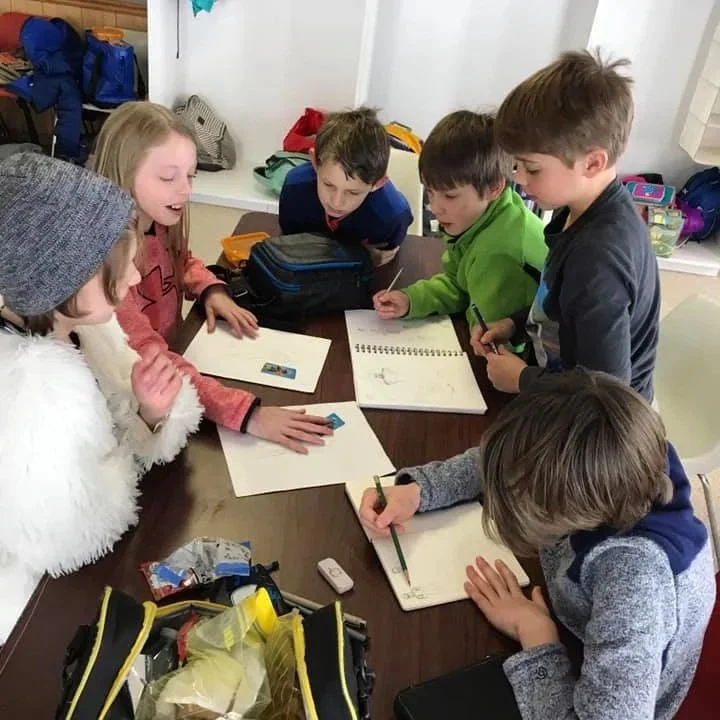
At Wildwood, we discern and articulate what we want to do, individually and as a group. Morning meetings are a space where we plan and share the available offerings for that week. Offerings are displayed on daily schedule boards and include any workshops, special topics, focus groups, classes, projects etc. offered by volunteers, subject matter experts, facilitators, parents and the kids themselves! There is no limit to what will be offered, and kids always have the choice to participate. Each person has the opportunity to share their personal intentions for what they hope to do that day and make any needed requests for support.
Creation/Action
During the day, the magic of self-directed learning unfolds! Children choose what to engage in and when: they create, explore, invent, collaborate, play, participate in chosen offerings/outings, eat when they are hungry, go outside when they want to and receive support from facilitators as needed.


Reflection
At the end of each day, children gather in small groups to reflect on the day. Documentation tools can be used to self-assess, notice patterns in use of time, and plan for the future.